
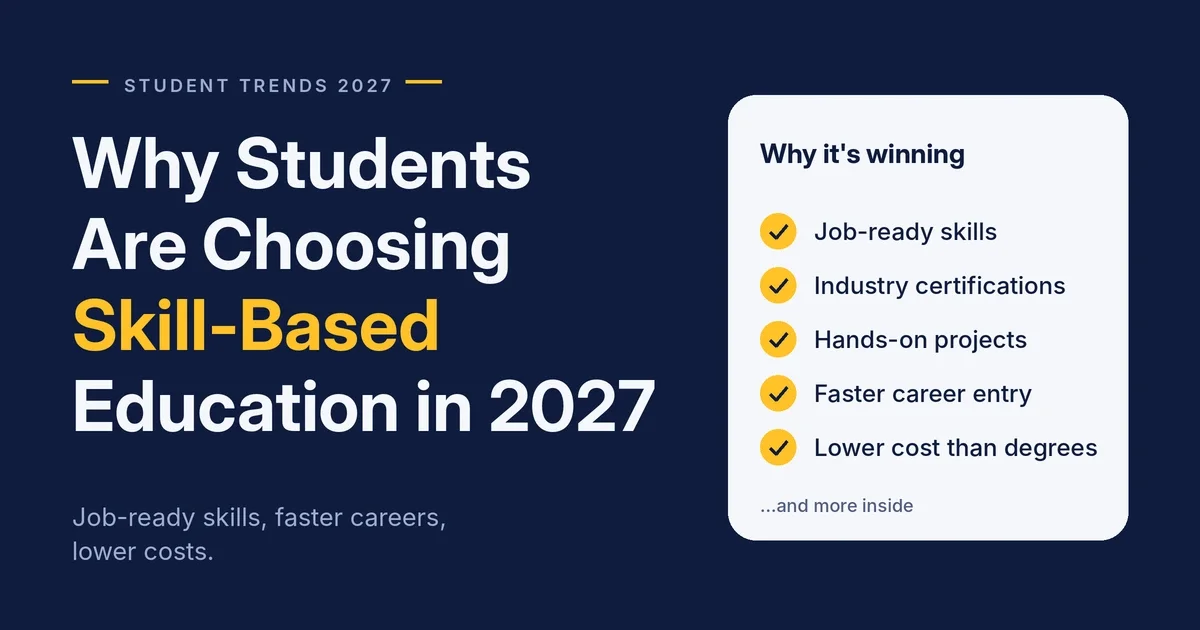
Why Students Are Choosing Skill-Based Education in 2027
For a long time, the plan after Class 12 looked the same for almost everyone. Pick a stream, join a college, spend three or four years on a degree, and hope a good job is waiting at the end. That plan worked for earlier generations. It feels a lot less certain today.
As the 2027 admission season approaches, more students and parents are asking a different question. Instead of "Which degree should I take?", they are asking "What will I actually be able to do when I finish?" That small change in thinking explains why skill-based education has moved from the side lane to the main road.
This blog explains what skill-based education really is, why it has become popular, how it differs from a regular degree, and how to decide whether it suits you.
What Is Skill-Based Education?
Skill-based education is learning built around doing. The course is designed to teach you specific abilities that employers need, such as writing code, running a laboratory test, managing a digital marketing campaign, analysing data, or handling hotel operations. You learn the concept, then you immediately use it on real tasks, projects and internships.
These programmes go by many names: vocational degrees, diplomas, job-oriented courses, certificate programmes, work-integrated programmes. The format can differ, but the idea is the same. By the end, you should be able to show what you can do, not just what you have read.
A regular degree is not useless, and nobody is saying it is. It builds a strong foundation of theory and thinking. The issue is that theory alone often leaves a gap between the classroom and the workplace. Skill-based learning tries to close that gap.
Reason 1: Employers Now Look at What You Can Do
The biggest push comes from the job market. Companies in technology, healthcare, digital media and many other sectors have changed how they hire. Many now care less about the name of your degree and more about whether you can handle the work from your first week.
Think about how a hiring manager sees it. Training a fresh graduate who knows the theory but has never used the tools takes months, and that costs money. A candidate who has already worked on projects, used industry software and spent time in a real workplace is easier to hire and quicker to become useful.
That is why a student with a strong portfolio, a few certifications and some internship experience can often compete well against someone with a longer degree but no practical exposure.
Reason 2: A Faster Route to Earning
Time matters, and so does money. Traditional degrees usually run for three to four years. Many skill-based programmes, including diplomas, certificates and accelerated courses, can be completed in one to three years, and some short ones in even less.
This has two clear benefits. First, you start earning earlier. Second, you spend less on tuition and living costs. With education loans a worry for many families, a shorter programme that leads clearly to a job looks like a safer investment.
Some work-integrated models take this even further. In these, a student joins a company right after Class 12, earns a salary, learns on the job, and studies for a degree through a partner university at the same time. For students who want financial independence early, this is a very attractive option.
Reason 3: Learning That Matches How Fast the World Changes
Technology moves quickly. A syllabus that takes a year or two to revise can fall behind the tools companies are already using. Skill-based courses are usually built with industry input, so the content stays closer to what is happening in the real world.
Many programmes are also modular. You can learn one skill, use it, then add another later. This suits a world where careers no longer follow one straight line. Someone who learns data analysis today can add cloud skills next year or move into a related role later without starting from scratch.
This is why skill-based learning is often described as future-ready. It does not just teach one tool. It teaches you how to pick up the next tool quickly.
Reason 4: Real Experience Before Graduation
Ask any recent graduate what they wish they had before their first job, and many will say experience. Skill-based programmes try to give it early. Internships, live projects, lab work, field training and workshops are part of the course, not an extra.
This practical exposure does more than build ability. It builds confidence. A student who has already handled real projects walks into an interview with examples to talk about, instead of only definitions.
Reason 5: More Paths to a Good Career
Not every successful career needs a long, theory-heavy degree. Graphic designers are hired on the strength of their portfolios. Developers are often judged on coding tests and projects. Digital creators can build an audience and an income directly. Healthcare support roles, such as lab technology, radiology and emergency care, depend heavily on trained, hands-on professionals.
As society becomes more open to these paths, the pressure to follow one fixed route is falling. Families are more willing to accept that a diploma or a skills-focused degree can lead to a respectable, stable career.
Reason 6: Online Platforms Made Learning Easier to Reach
Online learning platforms have made it possible to study from anywhere, often at a much lower cost than a traditional programme. Students from small towns can now learn skills that were once available only in big cities.
The shift to online and hybrid learning during the pandemic also changed attitudes. Students, teachers and employers saw that flexible, remote learning can work, and that portfolios and online assessments can show ability just as well. Many of those habits stayed.
Reason 7: Students Think About Return on Investment
Today's students are practical. They compare the cost of a course, the time it takes, and the likely outcome. They want to know what kind of job it leads to and whether the learning will stay useful.
Skill-based programmes answer these questions more directly. When a course clearly connects to roles such as data analyst, lab technician, web developer, digital marketer or hospitality professional, the path feels easier to trust.
Reason 8: Support from Governments and Universities
Skill development has become a priority for many governments and institutions. New policies encourage vocational and skill-based pathways, credit systems let students move between certificates, diplomas and degrees, and universities are partnering with industry to design courses and offer recognised qualifications.
This support matters because it reduces the old worry that skill-based courses lead nowhere. In many cases, you can complete a diploma and later continue to a degree, so you do not close any doors.
Skill-Based vs Traditional Education: The Real Differences
Here is a simple comparison to help you see the contrast clearly.
| Factor | Traditional Degree | Skill-Based Programme |
|---|---|---|
| Main focus | Theory and academic knowledge | Practical skills and job tasks |
| Duration | Usually 3 to 4 years | Often 1 to 3 years, sometimes shorter |
| Learning style | Lectures, notes, written exams | Projects, labs, internships, live work |
| Cost | Generally higher overall | Often more affordable |
| Job readiness | May need extra training after graduation | Closer to ready from the first day |
| Curriculum updates | Slower to change | Often updated with industry input |
| Flexibility | Fixed structure | Modular, with room to add skills late |
| Entrepreneurship | Possible but not always supported | Often a strong focus |
| Best suited for | Students who enjoy academics, research or fields that need deep theory | Students who prefer learning by doing and want to enter work sooner |
A few points are worth explaining beyond the table.
How you are assessed: A traditional course usually measures you through exams. A skill-based course measures you through what you produce: a project, a working app, a lab result, a campaign, a portfolio.
How you enter the job market: With a traditional degree, you often start applying after graduation and learn the practical side on the job. With a skill-based course, much of that practical learning has already happened.
How you grow later: A traditional degree gives depth in a subject. A skill-based path gives you quick entry and room to keep adding skills. Both can lead to strong careers, but they work differently.
Which Fields Are Popular in 2027?
Based on current hiring trends, several areas keep coming up for students who want job-focused learning:
- Technology: web and software development, data analytics, cloud computing, cybersecurity, and AI-related skills.
- Digital marketing: search optimisation, social media, content and analytics, which almost every business now needs.
- Hospitality and tourism: hotel operations, travel services and event management.
- Finance and accounting: professional accounting and analysis roles.
- Design and media: graphic design, UI design and content creation.
- Veterinary and agriculture-related work: especially useful for students in semi-urban and rural areas who want to build local careers or start their own ventures.
- Healthcare and allied health: medical laboratory technology, radiology and imaging, optometry, physiotherapy, emergency medical technology and dialysis technology. Demand for trained support professionals stays high.
Starting salaries vary a lot by field, city, skill level and the quality of the programme. Some published estimates put entry-level pay for popular fields in the range of roughly two to seven lakh rupees per year, but treat any such figure as a rough guide, not a promise. Your own skills, projects and attitude will matter more than the course name.
Skills Employers Look For Beyond the Course
Technical ability alone is not enough. Employers repeatedly mention a few softer abilities that help freshers stand out:
- Clear communication
- Problem-solving
- Teamwork
- Comfort with digital tools
- The ability to adapt and keep learning
- Critical thinking
A good skill-based programme builds these through group projects, presentations and workplace exposure. If a course ignores them completely, that is worth noticing.
Is Skill-Based Education Right for Everyone?
Honestly, no. It is a strong choice, but not the only good one.
If you want a career in research, teaching, law, or fields such as medicine and engineering at the degree level, a traditional route may be necessary. And even there, adding practical skills on the side will help you.
Skill-based education tends to suit you if you learn best by doing, want to start earning sooner, prefer a clear link between your course and a job, or dream of starting your own work.
The most sensible view, and the one many educators now share, is that the future is not a fight between the two. It is a mix. Degrees will include more practical training and skill certificates, and skill-based programmes will connect to degrees through credits and bridge options. The student who combines both understanding and ability will be in the strongest position.
How to Choose the Right Programme
Because the term "skill-based" is used widely, not every programme delivers the same value. Before you apply, check a few things:
- Know your interest. Choose a field you can see yourself doing for years, not just one that is trending.
- Check industry demand. Look at whether employers in your area or online are actually hiring for these roles.
- Look at the practical part. Ask how many internships, labs and live projects are included, and who supervises them.
- Ask about recognition. Make sure the qualification is recognised and, if you may want a degree later, ask how you can continue studying.
- Be careful with big promises. No course can truly guarantee a job. Look at placement records, speak to current students or alumni, and read details instead of slogans.
- Compare costs honestly. Include fees, materials and living costs, then compare with the likely starting pay.
Conclusion
Students are not choosing skill-based education in 2027 because it is fashionable. They are choosing it because the reasons are practical: employers want ready talent, careers change quickly, time and money are limited, and technology has made learning easier to reach.
A degree still has real value, and a good one can open many doors. But a certificate alone is no longer the finish line. What you can do, show and keep learning matters more every year.
Whichever path you take, add real skills to it. Build projects, do internships, learn the tools of your field, and keep improving. That habit will serve you longer than any single course.
A FEW MORE ANSWERS
Frequently asked questions
What is skill-based education?+
It is learning built around practical ability. You study the concept and then use it through projects, labs, internships and real tasks, so you finish with skills you can show, not just theory you have read.
How is skill-based education different from a traditional degree?+
A traditional degree focuses on theory and exams, usually over three to four years. A skill-based programme focuses on hands-on work and is often shorter, between one and three years. Traditional degrees build deep subject knowledge, while skill-based courses aim to make you job-ready sooner.
Why are more students choosing skill-based courses in 2027?+
Employers increasingly look at what a candidate can do. Students also want to start earning sooner, spend less on tuition, and learn tools that are in use today. Online learning and government support for skill development have made these paths easier to reach.
Can a skill-based course guarantee a job?+
No course can truly guarantee one. These programmes improve your chances because you gain practical experience and a portfolio, but the result still depends on your skills, effort and the job market. Check an institution's real placement record before you trust any promise.

ABOUT THE AUTHOR
Anjunath L
Expertise SEO, Digital Marketing, Social Media Marketing, Performance Marketing, Search Engine Optimization
Hi, I'm Anjunath, a Digital Marketer passionate about helping businesses grow their online presence through effective digital marketing strategies.I specialize in Search Engine Optimization (SEO), social media marketing, content marketing, and performance marketing. I enjoy researching the latest digital trends, understanding audience behavior, and developing strategies that improve website visibility and engagement.My goal is to share useful digital marketing knowledge, practical insights, and actionable tips that help businesses strengthen their online presence and achieve sustainable growth.
Good ideas travel.
Share this story with someone who’ll find it useful.
Last updated 24 Nov 2026, 05:28 PM IST